How Apollos Works
Apollos lets users allocate to vaults that target linearized yield by combining base-asset exposure with delegated USDC credit.
At a glance
- Deposit a supported asset (
WETH,WBTC, orLINK) and receiveafTokenshares.- Apollos Vault borrows delegated
USDCfrom Aave using credit delegation.- User asset + borrowed USDC are deployed into Uniswap v4 market pools.
- Rebalancing logic keeps the position close to its target risk profile as price moves.
- A protection layer (LVR hook + workflow controls) is used to reduce toxic flow.
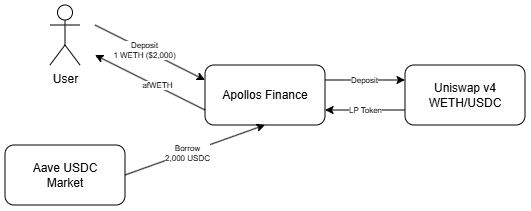
In simple terms: your deposit goes into Apollos Vault, the vault borrows extra USDC from Aave (through delegated credit), then both are used in Uniswap v4 to run the strategy.
⁉️The Problem: Impermanent Loss
In a standard constant-product AMM (x * y = k), liquidity providers are continuously rebalanced between asset and stablecoin.
That creates underperformance versus simply holding when price trends strongly in either direction.
Detailed example
- Start position:
1 ETH ($2,000)+$2,000stablecoins. - ETH price doubles from
$2,000to$4,000. - A classic AMM LP ends around
0.707 ETH + ~$2,828. - New LP value is about
$5,656(depending on rounding/fee assumptions). - Just holding would be exactly
$6,000. - Result: about
5.7%IL versus hold before fees.
Some protocols try to offset this with token emissions. That can help short term, but it is usually a subsidy layer, not a structural IL fix.
💡The Solution: Apollos 2x Delta-Neutral Vault
Apollos targets a linearized profile by pairing user collateral with borrowed USDC and managing leverage at vault level.
-
Deposit base asset User deposits into an Apollos vault and receives
afTokenshares. -
Borrow delegated USDC Apollos Vault draws USDC from Aave through a credit delegation line assigned to the vault.
-
Deploy dual-leg liquidity Collateral leg + borrowed USDC leg are deployed into Uniswap v4 pools via the vault strategy path.
-
Maintain target profile When price moves, the vault rebalances debt/collateral alignment toward its configured leverage target.
The goal is to reduce IL drag and keep a more stable risk-adjusted growth curve than passive LPing.
Why this is designed to kill IL drag
In a normal AMM, LP value tends to scale with sqrt(p) as price moves (p = price ratio).
With Apollos' 2x vault structure (collateral leg + delegated USDC debt leg), the net position is engineered to scale closer to p around its target regime, not pure sqrt(p).
That is the key intuition: reducing sqrt(p) drag is how Apollos targets IL at the root strategy level, instead of relying only on token incentives.
⬛Comparing Outcomes Across Price Moves
The table below is a simplified illustration (ignores trading fees, borrow cost, and execution friction) to isolate IL behavior:
| Asset move | Just hold (1 ETH + $2,000 USDC) | Classic x*y=k LP | Apollos (2x leverage) |
|---|---|---|---|
| -50% | $3,000 | ~$2,828 (about -5.7% vs hold) | $3,000 (+ fees) |
| 0% | $4,000 | $4,000 | $4,000 (+ fees) |
| +50% | $5,000 | ~$4,899 (about -2.0% vs hold) | $5,000 (+ fees) |
| +100% | $6,000 | ~$5,657 (about -5.7% vs hold) | $6,000 (+ fees) |
Practical outcome: users keep fee exposure while reducing directional IL drag versus conventional LP-only positioning.
📊What Happens When Price Changes?
Apollos continuously tracks leverage, debt ratio, and health factor (HF = collateral value / debt value in simplified terms).
When deviation grows, the vault can rebalance toward its target profile.
📈Asset price goes up (debt too low)
- Debt ratio drops below target
Collateral value rises, while USDC debt is relatively smaller. - Rebalance signal appears
Strategy checks show under-leveraged state versus target 2x profile. - Vault re-levers
Vault borrows additional delegated USDC from Aave and redeploys into Uniswap v4 strategy legs. - Back toward target
Debt/Collateral ratio moves back to the intended range, while HF remains healthy.
📉Asset price goes down (debt too high)
- Debt ratio climbs above target
Collateral value falls, but outstanding debt stays. - Risk control trigger
Health factor buffer shrinks and the position needs de-leveraging. - Vault de-levers
Vault reduces exposure, withdraws part of strategy liquidity, and repays a portion of Aave debt. - Back toward target
Position returns to safer leverage and HF buffer improves.
Where Chainlink workflow fits
- Chainlink workflow observes off-chain risk conditions and supports risk-state updates for protocol protection.
- The same risk-awareness layer helps keep vault operations aligned with target safety ranges (including HF buffer discipline).
- In high-volatility windows, protection logic can tighten execution conditions while vault rebalancing keeps leverage in range.
🛡️Protection Layer: Why Apollos Is Different
- Restricted direct pool access: intended flow is through Apollos vaults, not unrestricted direct LP routing.
- LVR-aware hook controls: dynamic fee logic helps defend against toxic/JIT flow.
- Workflow-driven operations: off-chain signals can trigger risk responses for on-chain execution parameters.
⬜Using Apollos: User Flow
- Select an Earn vault (
afWETH,afWBTC, orafLINK). - Deposit asset from wallet (or bridge from supported source flow).
- Receive
afTokenshares representing vault position. - Vault auto-manages debt + collateral composition and rebalancing.
- Withdraw by redeeming
afToken; underlying position is unwound by vault logic.